03 — Our Product
The real Eco-Notebook made by us
100% Recycled
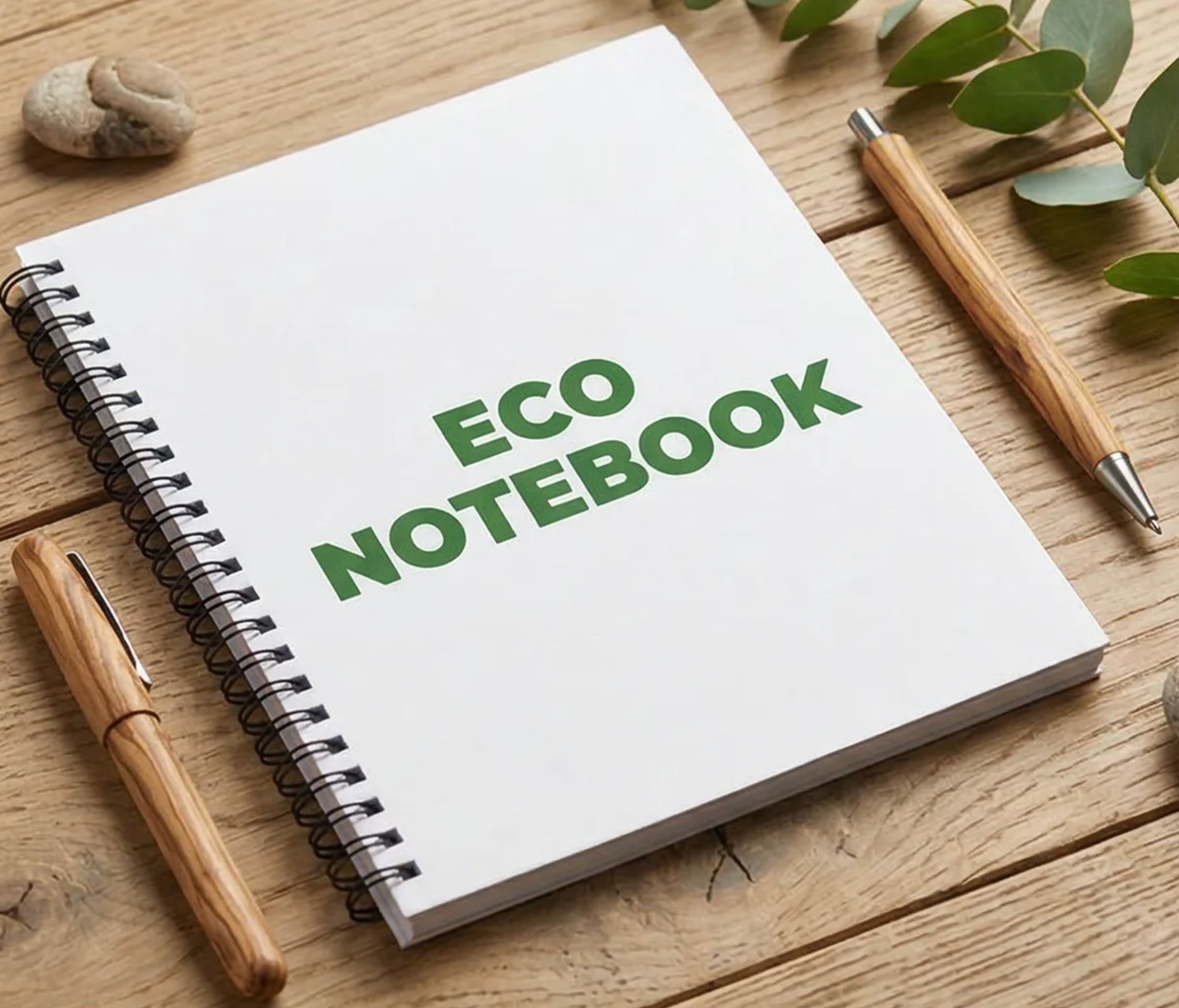
Water-resistant pages
Smooth writing surface
Spiral-bound & durable
100% recycled plastic
Works with ballpoint, gel & pencil
Eco-Notebook Project · Malaysia Olympiad
Every notebook rescues 6 plastic bottles from our oceans & saves a tree. 100% recycled plastic.
Calculate Your ImpactBy Umar, Sulaymon & Muhammadsoleh
01 — The Problem
The Great Pacific Garbage Patch is 4× larger than Tajikistan — 566,040 km².
Of all plastic produced is never recycled — ending up in landfills and oceans.
Only a fraction of the world's plastic is recycled. We're here to change that.
02 — Deforestation
trees cut down every year for paper production
Paper manufacturing is a leading cause of global forest loss — destroying habitats and biodiversity.
Paper mills discharge toxic chemicals into rivers and ecosystems, threatening aquatic life.
Deforestation accounts for up to 10% of global CO₂ emissions — accelerating climate change.
03 — Our Product
04 — How It's Made
PET bottles collected from communities, beaches, and recycling points.
Sorted, cleaned, processed into fine plastic fiber for pages.
Fibers compressed into smooth, durable writing sheets.
Sheets bound into finished notebooks — waterproof & planet-friendly.
05 — Key Metrics
We transform plastic pollution into high-quality notebooks — giving waste a second life as a tool for learning.
06 — Why Us
| Feature | Traditional | Eco-Notebook ✓ |
|---|---|---|
| Material | Tree paper | Recycled plastic |
| Env. cost | High deforestation | Zero trees cut |
| Plastic | Ignores it | Solves it |
| Carbon | High | Significantly lower |
| Cost/unit | $2–5+ | $1.70 |
| Durability | Water-damaged | Water-resistant |
Most projects tackle plastic OR deforestation. We address both.
At $1.70/unit we undercut conventional notebooks.
Waste becomes resource. Pollution becomes education.
07 — Your Impact
Number of notebooks
08 — Economics
| Qty | Cost | Bottles | Revenue | Margin |
|---|---|---|---|---|
| 100 | $170 | 600 | $250 | 47% |
| 500 | $765 | 3,000 | $1,100 | 44% |
| 1,000 | $1,450 | 6,000 | $2,000 | 38% |
Retail ~$2.50/unit · Break-even ~428 units
09 — Impact
Each notebook = 6 bottles rescued from landfills & seas.
Zero trees cut. Replaces traditional paper manufacturing.
Affordable at $1.70. Durable for students everywhere.
10 — Vision
Pilot production, partner with local schools, gather feedback & refine process.
Expand to 10+ cities, partner with recycling centers, train youth entrepreneurs.
International distribution, open-source manufacturing, 1M bottles rescued annually.
11 — FAQ
"We didn't wait for the world to change. We made a notebook and started changing it ourselves."
— Umar, Sulaymon & Muhammadsoleh
The Team
Three young minds from Tajikistan, united by a single mission — to turn waste into wisdom.
Leads manufacturing and product development.
Drives research, financial modelling, and strategy.
Creative vision and sustainable innovation.